What is the Choice Challenge?
Updated: 1 day ago

What is the Choice Challenge?
There is no such thing as a "bad child." There are only poor choices and better choices.
This is the whole system in one sentence. And it changes everything.
When we say "you are being bad," the child hears "I am bad." The label sticks. Shame shuts down the brain. Learning stops. The child stops trying because they have concluded the outcome is already decided.
When we say "this was a poor choice," the child hears "I can do better." The door stays open. The next choice is still available. This is the difference between a dead end and a launch pad.
What it is:
The Choice Challenge is a behavior management system built on six core decisions. Not rules. Choices. Skills a child learns, practices, and owns.
1. Follow Directions - Act when asked, without reminders.
2. Use Words - Name it, say it, explain how it hurt.
3. Own Behavior - "I apologize for ___." The choice to acknowledge and resolve.
4. Wait and Take Turns - "Not now. When I am finished, you can have it." Or, say no.
5. Breathe and Calm - First we breathe. Then we calm. Then we talk.
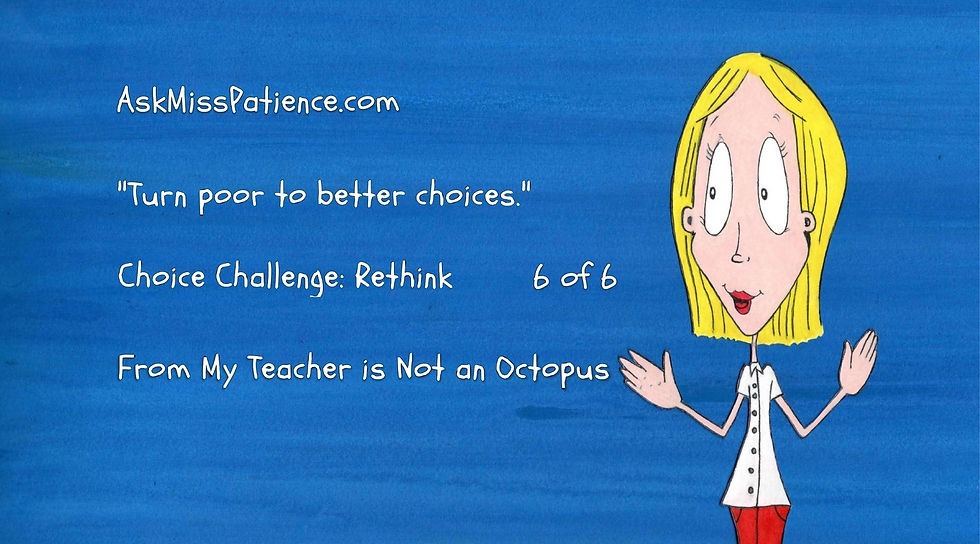
6. Rethink - "My first choice was ___, and why. My new better choice is ___."
Six choices. This is the starting line. Not the finish line.
This is not the end of the list
Every day, new options can appear based on the circumstance. A child discovers that spitting is a poor choice they had not considered. A teenager realizes there is a better option, and this is their choice. An adult catches themselves saying "you are so annoying" instead of "I am frustrated, and here is what I need." The system does not end at six. It grows every time someone names a new choice and picks a better one.
This is the point. The six choices are the frame. The content keeps changing. The skill stays the same: see the choice, name it, pick a better one.
What this removes:
Shame. The "I am bad" story. The sticker chart that tells a child their worth is conditional. The time-out that says "you are the problem." The Choice Challenge says: you are not the problem. The decision was. Let us find a better one.
What this adds:
Full accountability may result in a consequence. This might mean confronting the poor choice, rethinking, owning it with an apology, and making amends.
The child names the choice. The child picks the next one. The adult models the same process out loud, in real time, with their own poor choices and better ones. This is how a child learns that grown-ups are not perfect either. They just keep choosing better.
Why it works: The Swiss Cheese Theory
Children through to adults have holes in their learning. Maybe it is a lack of understanding about how to share, or how to calm down when angry, or how to use words instead of hitting. These holes are where poor choices fall through.
Our job is not to yell at the child for falling through the hole. Our job is to fill the hole with a better choice. We do this through clear modeling and consistent practice. When we see a hole, like a child who does not know how to wait their turn, we do not punish them for not waiting. We patiently teach them the skill of saying "Not now, I am using it," and we celebrate when they use it. We fill this hole with a better choice, making the child more whole.
I did not invent the Swiss Cheese idea from scratch. A psychologist named Urie Bronfenbrenner spent his career studying how children grow, and he found that no single thing shapes a child in isolation. He called it a set of nested systems. The immediate people around a child, the connections between those people, the broader culture, and time itself. His big insight: when one layer breaks down, the others feel it.
This is where PILES comes in. Physical, Intellectual, Language, Emotional, Social. Think of them like the five senses of learning. You need all five to navigate the world. But two of them are locked together, the way your nose and tongue work as a pair. Most of what you "taste" is actually smell. If your nose is blocked, your tongue cannot do its job. If your tongue cannot process what is in front of it, your nose has no signal to trust. They depend on each other.
The same is true for Emotional and Social in PILES. When someone struggles with emotional regulation, they struggle socially. And when they struggle socially, their emotions get more chaotic. They feed each other. This is why building the six choice muscles with practice matters. This is how we fill those gaps. How we close the holes.
Bronfenbrenner called the daily back-and-forth between a child and their world "proximal processes." This is just a fancy way of saying the nose and tongue at work, checking in with the environment, filling the holes, and telling the rest of the body it is safe to move forward.
How it works in practice:
You do not need a program. You need a language. "This was a poor choice. What is a better one?" Two sentences. Works for a three-year-old to an 18-year-old. Works in a classroom of kids from six continents when I taught full time. Works at the kitchen table at 9 pm when you are both tired and the dishes are still in the sink.
With ownership, we reflect. We look at the choice we made, the circumstances it created, and the people it touched. Then we pick a new one. Not because we were punished.
Because we can.
This is the Choice Challenge. Not a system to install. A practice to build. Filling the holes. Building choice fitness. One better choice at a time.
Where to go next:
If you have not already, read the book: My Teacher Is Not an Octopus: Self-Regulating Behavior Management Book with the class or your child. Check out the Choice Challenge guide for free in exchange for an email to keep up on what is new. Or buy the eBook for a few dollars. The choice is yours :)
Read the blogs: Six choice extensions and six activity posts at www.askmisspatience.com.
Try one new choice today. Just one. See what happens. If you have a success story or are feeling challenged, write this down and get in touch. These notes will help a lot of people if we work together to share our experiences to find better solutions together. You are not alone. Teamwork makes the dream work!
Choice Challenge Guide will be released in eBook and paperback. You will have the option to download for free by signing up or buy online. The choice is yours :)
About the author
Patience Filippo is a children's author, artist, educator, and veteran with decades of classroom experience. She created the Choice Challenge: Poor to Better Decisions for Everyday Behavior to help kids and grown-ups be better humans, one better choice at a time. The Choice Challenge is the framework behind My Teacher Is Not an Octopus, a self-regulating behavior management picture book for early learners. Begin at birth. Grow into lifelong learning.
Motto: Empowering happiness through literacy.
Find Patience online https://linktr.ee/askmisspatience